By Eliaser Ndeyanale and Nishi Felton | 22 February 2026
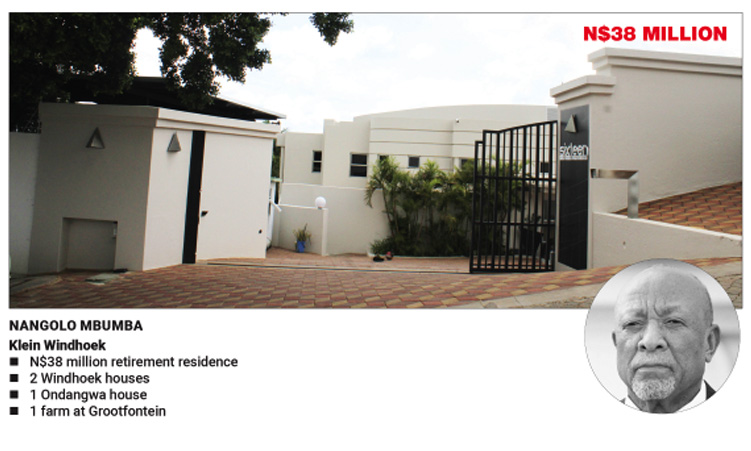
The government paid N$38 million for former president Nangolo Mbumba’s luxury retirement home in Windhoek.
The transaction is part of N$152 million that the state has spent on former presidents’ residences over the past decade.
Mbumba served as president from February 2024 to March 2025 after Hage Geingob died in office.
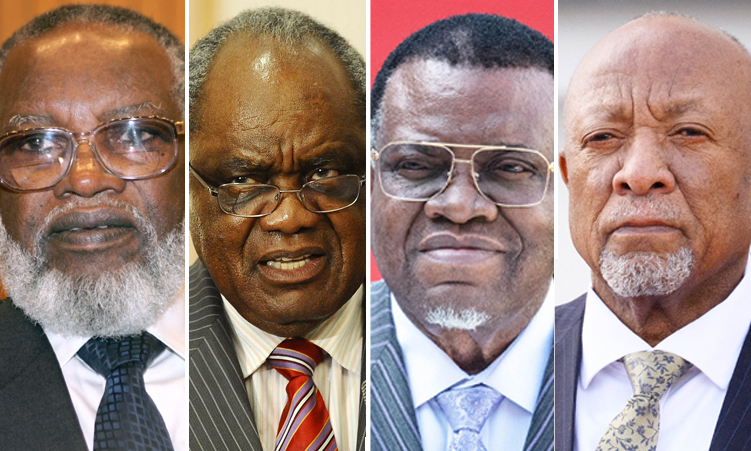
The Namibian’s calculations show the government has spent N$152 million on retirement homes for four former presidents: Sam Nujoma (N$43 million), Hifikepunye Pohamba (N$35 million), Hage Geingob (N$36 million) and Mbumba (N$38 million).
For context, N$152 million would allow the Shack Dwellers Association of Namibia to build more than 3 000 houses. A Namibian earning an average salary of N$252 000 per year would need to work for 603 years to earn that amount of money.
The free retirement houses have prompted ongoing debate about why the country should continue splashing luxury on presidents while the country languishes in poverty.
The Namibian understands that there was a draft bill being considered by Geingob to reduce the free retirement perks. But it was never processed.
President Netumbo Nandi-Ndaitwah is said to be leaning towards scrapping the perks that could reach over N$190 million if she also receives a N$40 million mansion.
CARETAKER PRESIDENT
Mbumba’s elevation as president sparked debate over whether he should be considered a full president entitled to the same benefits as an elected president.
By the end of 2024, only months after he was sworn in, the government was already finalising Mbumba’s retirement house.
The former Swapo secretary general already had a house at Ondangwa, two luxury houses in Windhoek, as well as a farm near Grootfontein, according to the National Assembly assets register for 2015.
Documents show that in October 2024, Mbumba, through the government, bought a house in the luxury suburb of Klein Windhoek for N$23 million.
The rest of the money, N$15 million, was allegedly used for renovations, furnishing the residence and other costs.
He bought the 1 650-square-metre property through a company called Inlandempire Investments, which was registered in May 2023.
In September 2024, two weeks before the purchase, it registered a change of director to Mbumba, who is now listed as the sole director of the company.
The previous owner of the property was Matfi Investments, a company that lists a Windhoek lawyer as its director.
State House executive director Mateus Kaholongo confirmed the purchase of the property for Mbumba in November last year.
“This house is now private property. I don’t have the mandate to publish the details of this private property as it encroaches on privacy,” he said.
“The house was bought before he retired from office. He has full details of his property. Please approach the owner for the information that you require,” Kaholongo added.
The house was handed over to Mbumba at the end of November last year. Kaholongo added that the house was renovated to make it fit for a former president, including security upgrades.
Kaholongo claimed that the property is smaller than the size stipulated in the Former Presidents’ Pension Act.
According to a 2022 report by The Namibian, the government also renovated Mbumba’s private farm on Waterberg Plateau for N$660 000. At that time, Mbumba was the vice president.
Although Mbumba has every right to the benefits as a former president, the benefits themselves need to be re-assessed, National Unity Democratic Organisation member of parliament Vetaruhe Kandorozu told The Namibian.
“Giving such an amount to an individual to contract one house for the president while the whole nation is homeless and living in abject poverty is a crime,” he says.
Former parliamentarian Mike Kavekotora questions the rising costs of presidential properties.
“I don’t understand how a property for an individual can cost millions of dollars.
What type of house is it? Even a farm does not cost N$40 million. How can a house cost N$30 million to N$40 million? I am seriously concerned about that,” he says.
HARAMBEE
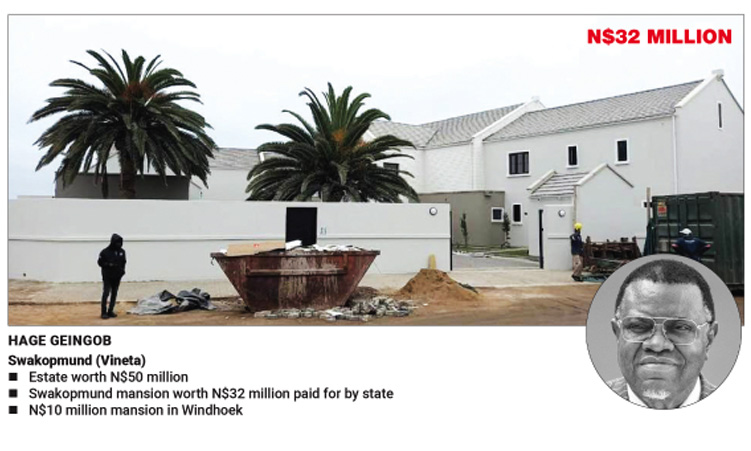
Two years ago, the government paid for Geingob’s retirement mansion in the Swakopmund suburb of Vineta.
Daily newspaper Namibian Sun reported last July that the government spent about N$32 million on that property.
The transaction was confirmed by then State House spokesperson Alfredo Hengari in 2024.
Hengari declined to reveal the amount allocated to the late president, but he confirmed that the property was undergoing renovations to “meet the standard requirements befitting a former president”.
The state had budgeted N$36 million for the project, which began in April 2023.
In April 2024, The Namibian reported that Geingob’s wife, Monica Geingos, inherited the Swakopmund property after Geingob’s death.
The house was an addition to Geingob’s personal wealth. When he died, his assets totalled N$50 million, excluding all the assets he had transferred to a family trust prior to his death.
In 2015, he declared that his private mansion, Casa Rosalia, was valued at N$8 million to N$10 million.
He also owned a farm at Grootfontein through his company, Hada Loha, which was estimated to be worth N$4 million in 2015.
OKANGHUDI RESIDENCE
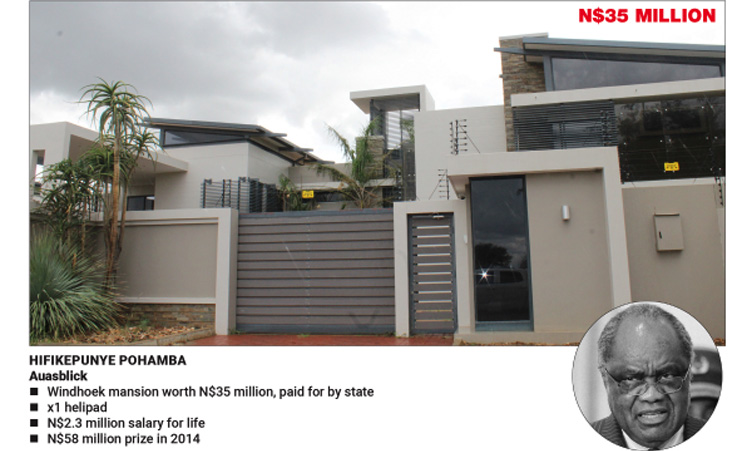
Unlike other former presidents, Pohamba’s wealth appears not to come primarily from property.
In 2014, he was awarded the Mo Ibrahim Prize, through which he received US$5 million (N$58 million) spread over 10 years.
After that, he receives US$200 000 (N$2.3 million) per year for life from the Mo Ibrahim Foundation.
But in line with his peers, Pohamba received a retirement home paid for by the state.
The Namibian reported in 2015 that the government spent N$35 million on his home in Windhoek’s Auasblick.
He named it Okanghudi Residence, after his village in the Ohangwena region where he currently resides.
The ground floor of Pohamba’s mansion includes four garages, three guest rooms, a dining area for 30 people, a main guest lounge, a private lounge, kitchen and laundry room, bar and braai area, a double-volume lobby, a library and an office.
The top floor has three family bedrooms, accommodation for staff, another two bedrooms, a family lounge, a gym and a helicopter landing pad.
Independent Patriots for Change chief whip Rodney Cloete told The Namibian this week that presidential benefits do not align with the state of Namibia’s economy and that the act should be amended.
“The act was written for a country that expected its leaders to retire modestly.
Instead, we’ve seen house renovations, cash payouts, mansions, salary for life arrangements, fleets of vehicles, and armies of domestic staff, all tax free, all for life, all inherited by spouses at 75%,” he said.
He said the money could be better spent providing housing for those who need it.
“That money could build over 400 low-cost houses. What serves Namibia better: a helipad at Klein Windhoek, or 400 families with a roof?” he asked.
FOUNDING PRESIDENT
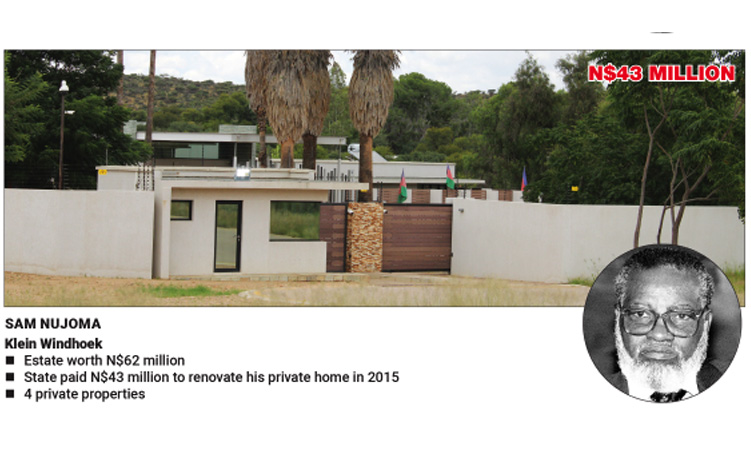
Nujoma has in the past been accused of benefitting twice from the Former Presidents’ Pension and Other Benefits Act.
Under the act, the president can choose between a multimillion-dollar state-funded house or cash on leaving office.
The Namibian reported in 2019 that government officials had said Nujoma declined a house offer when he stepped down in 2005 and received a cash payout.
While the value of cash payouts for presidents has never been made public, the value would be equivalent to a house built according to specifications in the act.
But in 2015, Nujoma’s personal residence was renovated at the expense of the state.
The Presidency in 2019 confirmed that the government had spent N$43 million on renovating the house.
That N$43 million now forms a large proportion of his personal estate, which was left to his wife and children.
Republican Party president Henk Mudge last November told The Namibian that parliament needs to amend the former presidents’ benefits, saying the money could be used for “much better purposes”.
“But what worries me most is that these retired presidents accept those benefits.
They know the financial and economic problems the country is facing, then they accept golden handshakes like that,” he said.
Nujoma also owned four other properties: at Henties Bay (N$5.9 million), Walvis Bay (N$5.3 million), Rehoboth (N$290 000) and Nkurenkuru (N$485 000).
The former president also owned Etunda farm, which could be worth up to N$40 million, but he transferred ownership of the farm to a trust before his death.
Human rights activist Phil ya Nangolo told The Namibian that presidential perks do not align with the experiences of everyday citizens.
“This state of affairs, therefore, is entirely consistent with Namibia having been classified as a most unequal distributor of income among its population – a rich country with poor people and a constitutional democracy without democrats,” he says.
EXPLAINER
The residences granted to former presidents are governed by the Former Presidents’ Pension and Other Benefits Act.
The legislation entitles a former president to a furnished official residence.
Alternatively, he or she may opt for a housing allowance or for the state to acquire or construct a private residence for him or her anywhere in Namibia.
The law places limits on the size of the house. The erven may not exceed 5 000 square metres and the residence must be reasonably sized.
“Reasonably sized” as defined by the law is a “house with five bedrooms, a guest wing with three bedrooms, a study, a swimming pool, two guardrooms and four garages.”
Popular Democratic Movement leader McHenry Venaani has for close to 20 years opposed the retirement perks in parliament.
In 2004, he said an impression was created that those who served in top positions were doing so to obtain a reward.
Now, he is doubling down, saying the benefits given to ex-presidents should be reformed.
“They are costing too much. It is wrong to give a house to someone who already has a house while the country’s population is suffering,” Venaani said.
He added: “In olden days, we were doing it because leaders wanted to stay in power, like the Ugandan president (Yoweri Museveni) for the rest of their lives.
Therefore, we have these benefits to incentivise them to leave office but this incentive has become a burden to the socio-economic strata, and the populace of the country needs to review them going forward.”
Under the law, a retired president is entitled to state-funded support, including security personnel, three drivers, two private secretaries, two personal assistants and two office attendants.
Water and electricity charges are covered by the government. The property must also be accompanied by workers, at the expense of the state.
The act further provides for a fully equipped office with telephones, computers, office furniture and other necessary materials.
These benefits are in addition to the tax-free pensions given to former presidents for life.
The pension is equal to their salary prior to leaving office or 80% of the incumbent’s salary.