
By Susan Comrie | 26 March 2026
Lawrence Mulaudzi lost a $1.2bn gas deal — for failing to pay a R725,000 debt to a soccer player — then seemingly lied under oath in court papers and later offered the footballer a cash settlement to try to get his deal with the state fuel company back on track.
In December 2023, Shumani Lawrence Mulaudzi signed a $1.2-billion (R20.3-billion) deal with state-owned PetroSA, appointing his company Equator Holdings to fund and build pipelines and other infrastructure for a future gas industry.
Four months later, though, Equator was liquidated for failing to pay a R725,000 debt to a soccer player.
“This discovery,” he later told the Gauteng Division of the High Court in Johannesburg, “shocked me considerably”.
The liquidation application had been granted without his knowledge, he claimed, and against the wrong company. And the sheriff who was supposed to serve the papers on him had instead left them stapled to the gates of a construction site that had once been his home address.
“To make matters worse, the first time that the liquidation proceedings came to my … knowledge was on 25 July 2024 when I saw an article by Susan Comrie of amaBhungane.”
And while Mulaudzi was trying to get up to speed with a case he had never heard of, PetroSA’s new CEO moved to cancel his contract.
“I engaged [my attorneys] for assistance. Investigations into the matter were conducted, including the reason [Equator] was liquidated, by whom, when and how.”
The only problem? Mulaudzi’s story under oath seems to be a fabrication.
Instead, court papers suggest that the man tapped to lead the roll-out of South Africa’s gas infrastructure lied to the court in a bid to escape liquidation, then — when that didn’t work — reached a cash settlement with the soccer player and the liquidators to withdraw from the case.
The result: the liquidation of Mulaudzi’s company, Equator Holdings, has been reversed, and according to a report from Africa Intelligence, there are also attempts to resurrect his R20.3-billion gas deal with PetroSA.
“The winding up of the company was set aside by the high court on 23 October 2025,” Mulaudzi’s lawyer, Nicqui Galaktiou, confirmed to us in December.
But when we asked for a copy of the judgment, Nicqui Galaktiou Inc — notorious among journalists for their aggressive defence of their clients — went quiet.
When we followed up with them in January, we were told: “Please note that we no longer represent Mr Lawrence Mulaudzi. In the event that amaBhungane intends to publish any article in this regard, we request that this firm be excluded from the content thereof. Thank you.”
They weren’t the only ones ducking accountability: from Mulaudzi to the lawyers to the soccer player and PetroSA, no one wanted to talk about this case. Here’s why.
The broke soccer team
Draw a line on a map from the offshore gas fields near Mossel Bay to the furthest point on South Africa’s border. The last town on the line is Thohoyandou in Limpopo, home of Tshakhuma Tsha Madzivhandila Football Club (TTM).
Two worlds — gas and soccer — that would never have met, if it weren’t for the club’s owner, Mulaudzi, and a piece of paper he filed with the National Soccer League.
In July 2022, former Bafana Bafana player Cheslyn Jampies agreed to join TTM as the captain.
“The first month came, our monies were short,” Jampies told us when we interviewed him in 2024. “Obviously, me, as the club captain, I stand as the mouthpiece between the management and the players. When we go and ask, ‘Hey, what do we tell the boys?’ Because we are the senior players, they come to us to help them financially … so we needed answers, and we never got that. We were brushed off many times, we were told, ‘Just hang on.’”
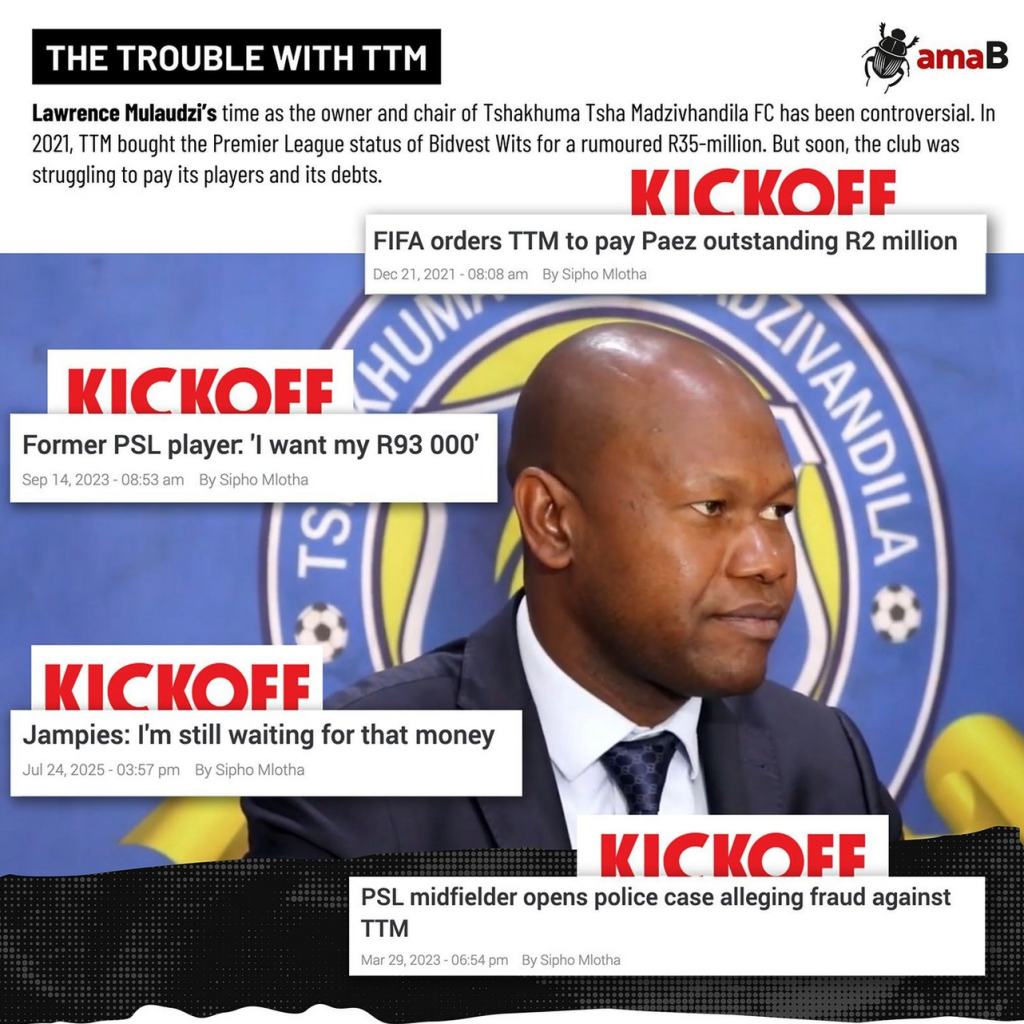
By November 2022, the club had stopped paying him altogether, and both sides agreed to part ways. At this point, the club owed Jampies two months’ salary. Total: R70,000.
When the club failed to pay, Jampies approached the Dispute Resolution Council of the National Soccer League (NSL), who ruled that the club should now pay him three months’ salary. Total: R105,000.
When the club ignored the ruling, the NSL awarded Jampies a damages claim. Total: R725,000.
Relegation
According to Mulaudzi, who is both the owner and chair, it was the team’s untimely relegation that was to blame for TTM not paying its debts.
“At the time of the award, TTMFC was a member of … the National First Division [and] entitled to a monthly grant of R575,000 during the season,” Mulaudzi told the high court. “The grants constitute the main source of income for the vast majority of PSL [Premier Soccer League] member clubs and are consequently used … to pay players’ salaries.”
The plan, he told the court, was to use the monthly grant to pay Jampies: “However, at the end of that season … TTMFC was relegated to a lower league. The consequence of this relegation was that TTMFC was not entitled to receipt of any grants. It was therefore unable to make payment.”
The relegation shouldn’t have come as a surprise, though. The final match of the season had been played in May 2023. So by June, when the NSL ruled in Jampies’ favour, the club knew it was out of cash.
The controversial piece of paper
By July 2023, it was clear that Mulaudzi’s TTM had no intention of paying, so Jampies approached the NSL for a copy of the club’s ownership record. (Soccer clubs are notorious for playing shell games with legal entities, Jampies’ lawyer, Evert de Bruyn, previously told us.)
According to the NSL’s records, the legal entity behind TTM was Mulaudzi’s investment company, Equator Holdings. The same Equator Holdings that had just been selected as the winning bidder for PetroSA’s R20.3-billion gas infrastructure deal.
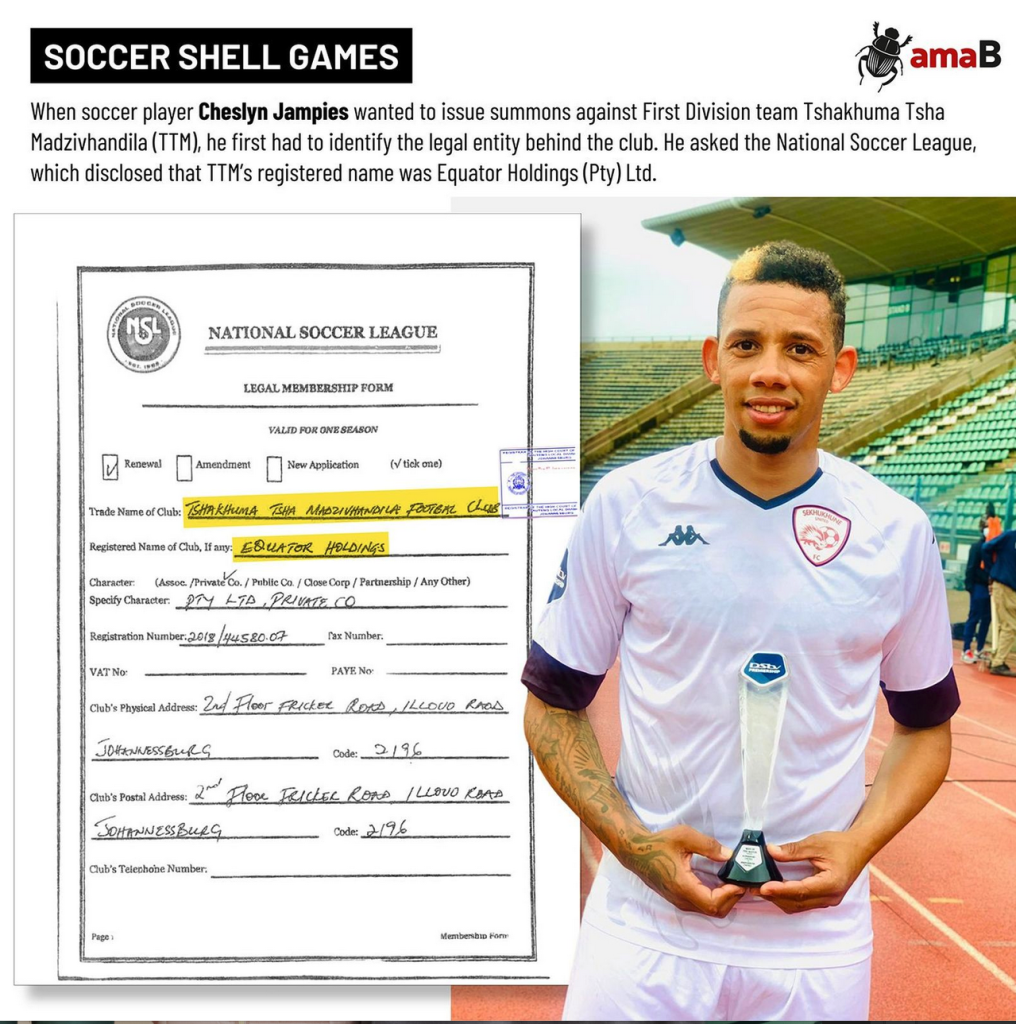
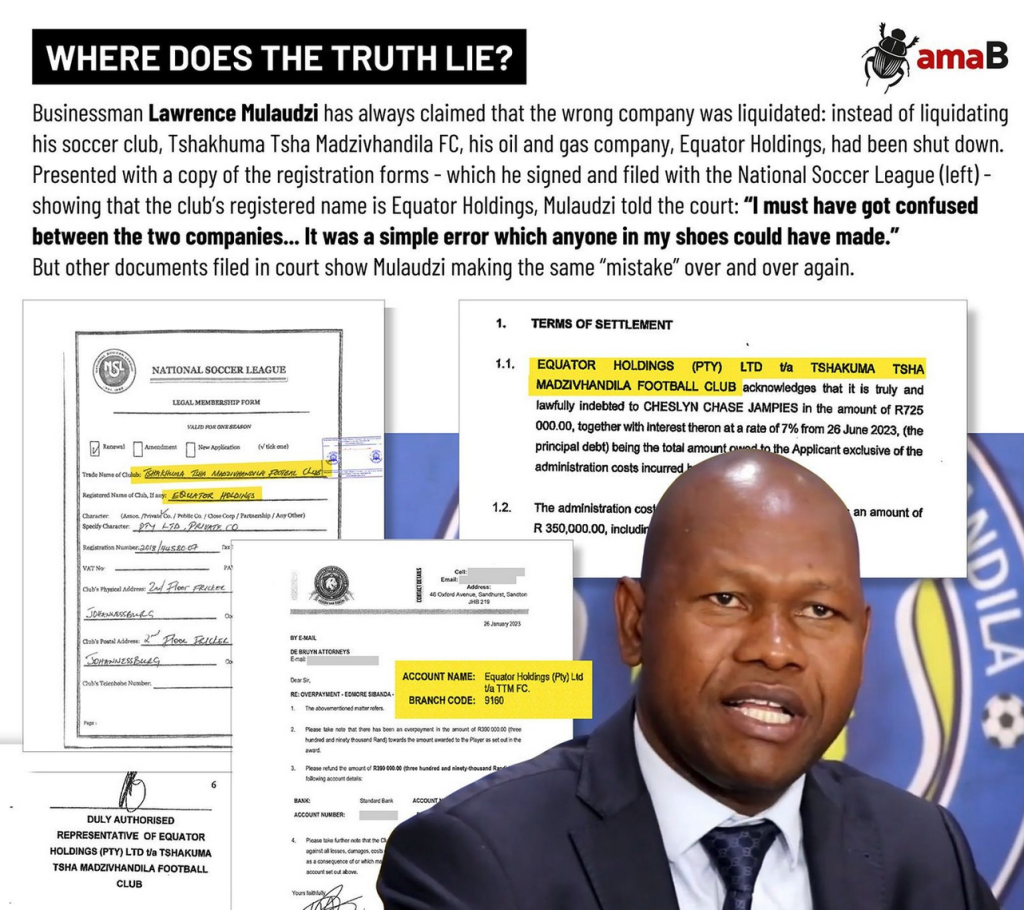
“The document is factually incorrect in that the TTMFC is not owned by [Equator Holdings]. It is, in fact, owned by a company established … in 2017 for that precise purpose … Tshakhuma Tsha Madzivhandila Football Club (PTY) Ltd,” Mulaudzi told the court in 2024.
“When I completed [the form], I must have got confused between the two companies… It was a simple error which anyone in my shoes could have made.”
The result, Mulaudzi would tell the court, was that the liquidation order, brought by Jampies in December 2023, “was … granted against the wrong company in these unfortunate circumstances”.
But the extent of Mulaudzi’s misleading narrative only became clear when Jampies filed his replying affidavit in January last year.
Jampies didn’t hold back: “This explanation,” he told the court, “is farcical and transparent. I will now deal with why it is also patently false.”
Another unpaid soccer player
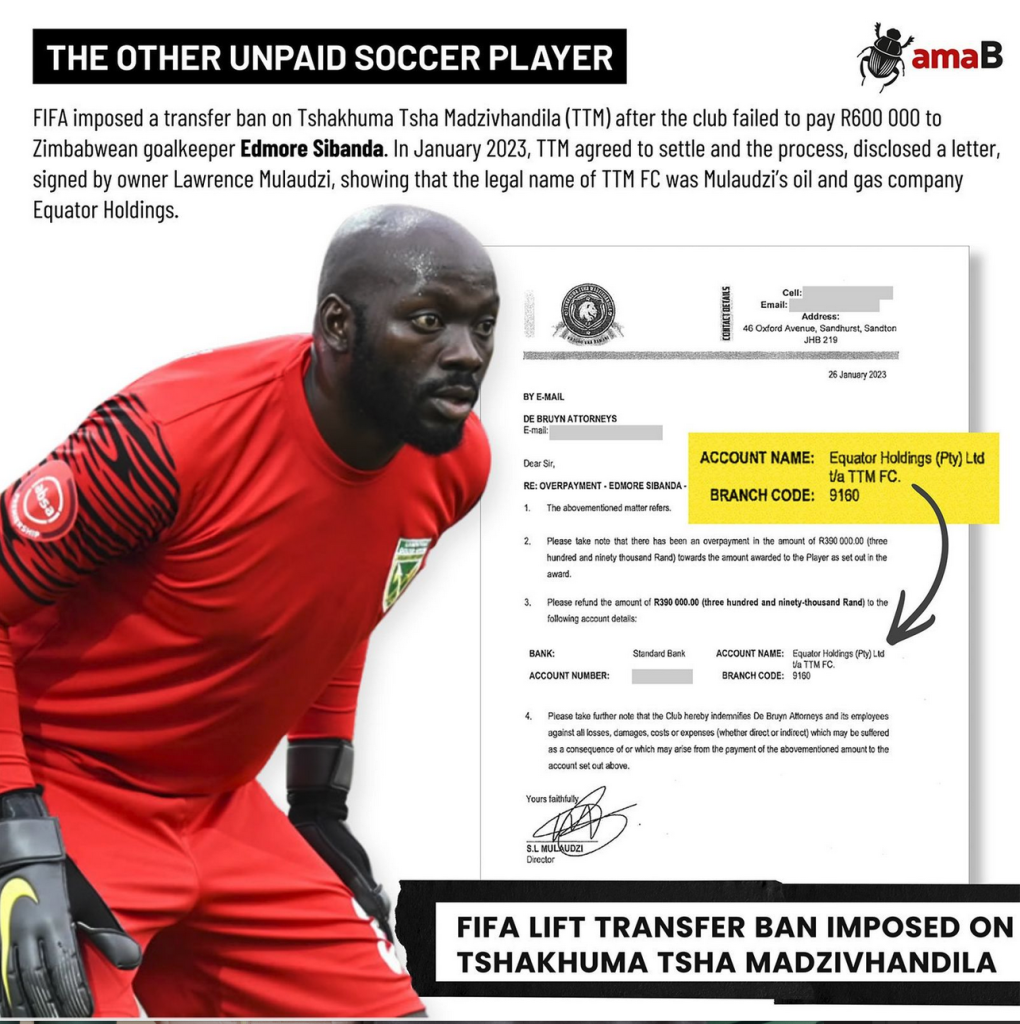
Back in August 2021, Zimbabwean goalkeeper Edmore Sibanda had signed a deal to join TTM, which had just bought the Premier League status of Bidvest Wits for a rumoured R35-million.
But things quickly soured after a career-ending injury forced him to retire, and TTM failed to pay R600,000 that they owed him. After Sibanda complained to Fifa, the international governing body, the club was hit with a transfer ban.
In January 2023, the club agreed to settle with Sibanda. But then, they accidentally paid him twice.
In an email, attached to the court papers, TTM’s then lawyer Kabelo Mashigo asked De Bruyn (coincidentally also Sibanda’s lawyer) to refund one of the payments. To process the R390,000 payment, De Bruyn asked for TTM’s Fica (Financial Intelligence Centre Act) documents, including details of who owned TTM.
According to the letter that Mashigo provided — signed by Mulaudzi — TTM’s legal name was Equator Holdings.
Blindsided
Mulaudzi has always claimed that the news of Equator’s liquidation had blindsided him, and that the first he heard of it was when amaBhungane published its article in July 2024.
We reached out to him before both this article and the 2024 article were published, but Mulaudzi ignored our calls and emails.
Instead, Mulaudzi told the court: “Had I known that the liquidation proceedings had been threatened or launched, I would immediately have taken any necessary steps to oppose it and to procure payment of the award to [Jampies].”
When the sheriff served the summons, Mulaudzi’s home in Sandhurst’s Oxford Avenue was undergoing a renovation: “The new entrance gate … was itself under construction at the times of the alleged services. It is presumably to this partially constructed gate that, according to the returns of service, the sheriff allegedly affixed the relevant documents,” he told the court.

This blunder, he claimed, meant that he never received the papers: “I cannot say why the sheriff did not make proper enquiries as to how he could access and enter the property in order to serve the document in question on a human being. Surely that was his duty? This state of affairs is wholly unsatisfactory. Not one of these services came to my attention or, to the best of my knowledge, to that of any responsible person who might have mentioned it to me.”
But here, again, Mulaudzi’s story falls flat.
‘Would Jampies take 200k?’
Court papers show that the final liquidation of Equator Holdings was granted on 7 March 2024.
According to Mulaudzi, the first time he learnt about the liquidation was 4½ months later.
But barely a week after the liquidation order was granted, TTM’s lawyer reached out to Jampies’ lawyer to discuss a settlement.
“Mashigo informed De Bruyn verbally that his client, Mulaudzi, had informed him of a liquidation served at his property,” Jampies told the court, attaching a confirmatory affidavit from De Bruyn.
We asked Mashigo if this was accurate, but emails to his sports agency, K4 Alchemy Consult, went unanswered.
There was also another reason for Mashigo to reach out: earlier that day, the soccer website KickOff had published an interview with Jampies in which he claimed he had received a court order liquidating the club.
Sunday World had already reported, back in December 2023, that Jampies was bringing a liquidation application, but now Jampies told KickOff that the court had ruled: “Because the outcome only came on Thursday [March 7, 2024], so they will serve Mulaudzi the papers around Monday.”
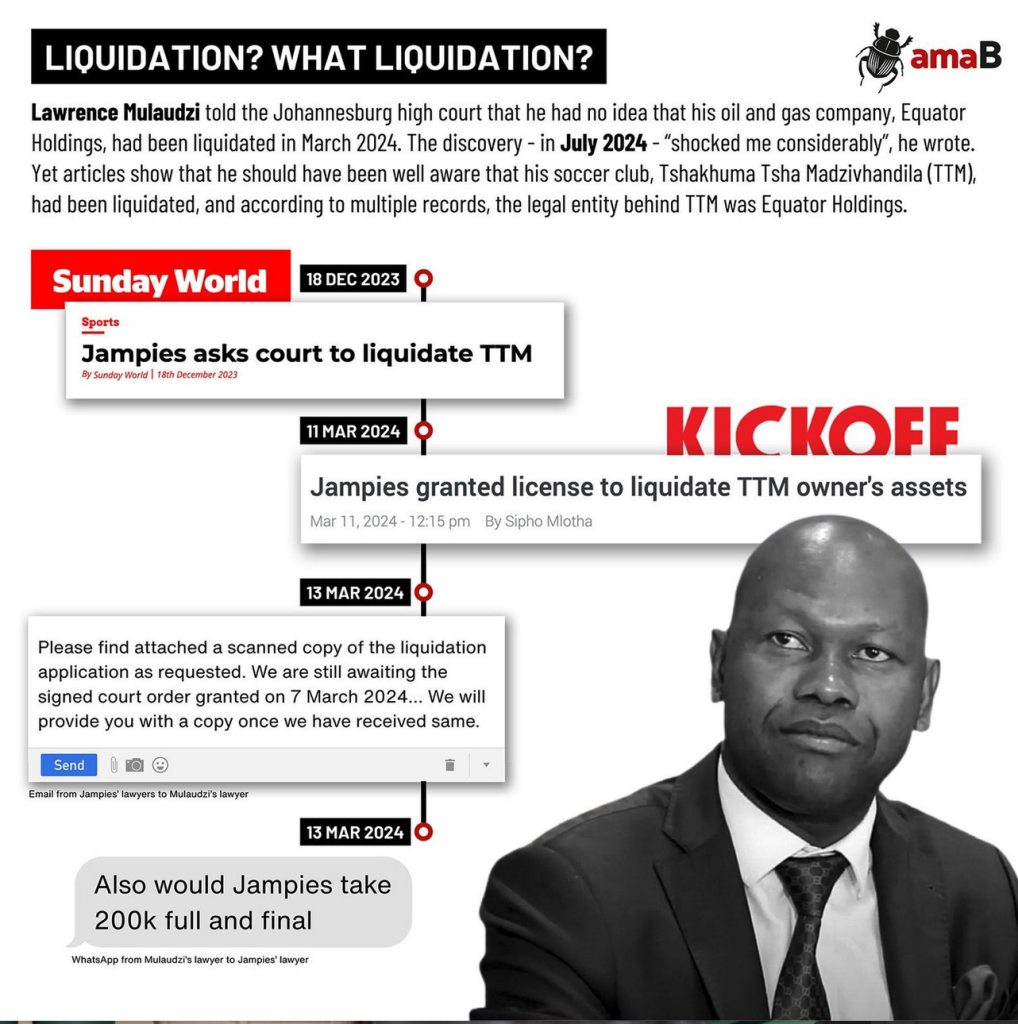
In a follow-up email to De Bruyn, Mashigo asked for “all documents filed on behalf of Mr Jampies in relation to any claim against TTM FC and/or Mr L Mulaudzi”. After De Bruyn emailed a copy of the court papers, Mashigo sent a WhatsApp: “[W]ould Jampies take 200k full and final?” he asked.
Financial undertakers
In seems impossible that, by April 2024, Mulaudzi didn’t know that his soccer club — and thus his R20.3-billion company — had been liquidated. Yet he was still pushing deals in Equator’s name.
In May, he submitted a proposal to the National Skills Fund, requesting a R3.5-billion grant which would be used to train artisans at PetroSA and — conveniently — would include R1-billion in funding to repair PetroSA’s offshore oil and gas rig.
He was also still approaching funders in a desperate bid to meet the 10 June 2024 deadline imposed by PetroSA’s R20.3-billion gas infrastructure deal.
Legally, though, Mulaudzi was no longer in control of his own company; it had been handed over to two liquidators: Bennie Keevy of Commonwealth Trust and Anneke Barnard of BDO.
The job of a liquidator is mercenary: where a business rescue practitioner is tasked with trying to steer a company out of financial trouble, a liquidator simply sells off the assets to settle any unpaid debts. More financial undertaker than emergency surgeon.
In August 2024, the Master of the High Court asked retired magistrate Martin Kroukamp to hold a commission of inquiry to identify any assets that Equator may have. In a summons, attached to the court papers, Mulaudzi was told to present himself at the offices of Senekal Simmonds law firm and bring all Equator’s financial records.
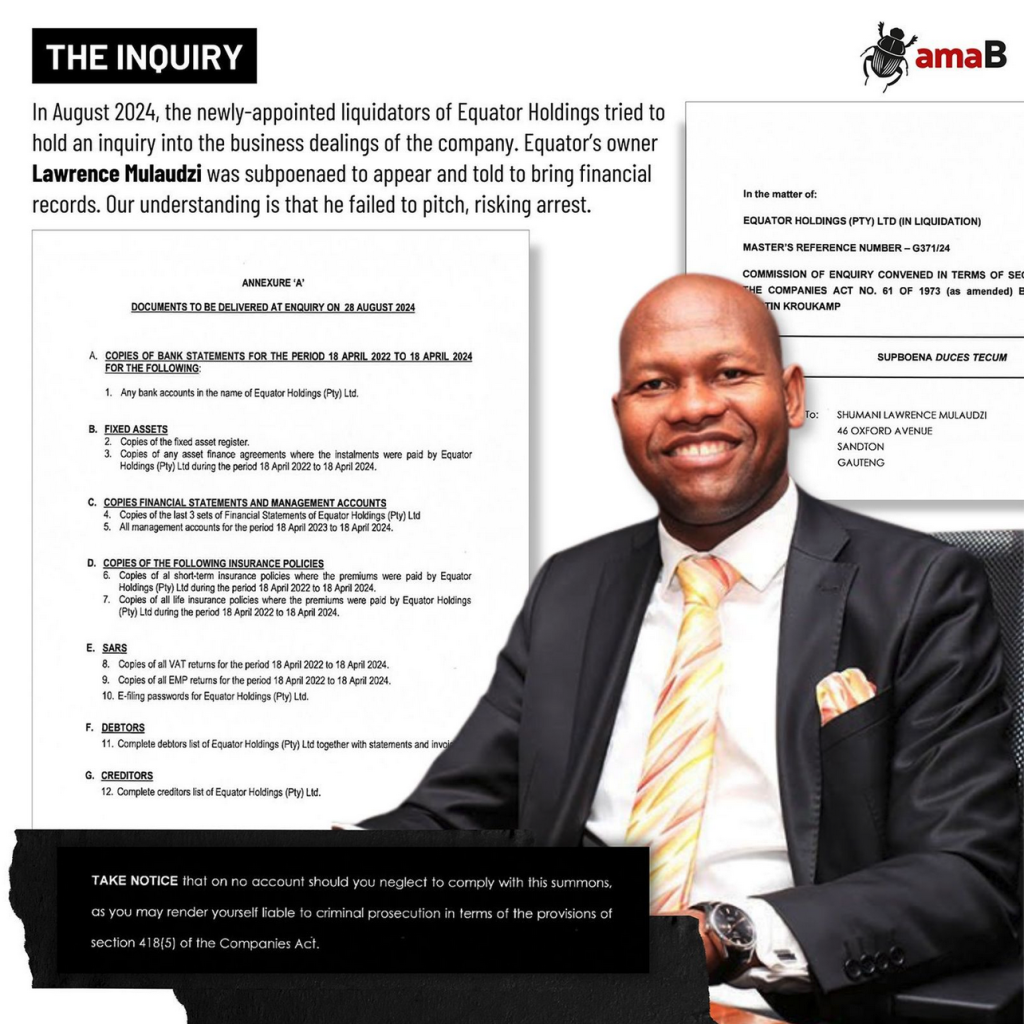
Our understanding is that Mulaudzi refused to appear. Kroukamp wouldn’t speak to us about what happened: “Due to the nature of [the inquiry] and the privacy entrenched in terms of section 417/418 [of the Insolvency Act], I am barred to disclose any information surrounding the matter,” he said in a WhatsApp.
He added: “The Enquiry never proceeded as the relevant parties reach [sic] a settlement before any evidence was taken.”
Equator’s co-director, Markam Naidoo, disputed this. He said he had appeared at the inquiry and told it what he knew about the business, but that Mulaudzi appeared to be “unreachable”.
Instead, Mulaudzi decided to fight.
The door opens
In November 2024, Mulaudzi approached the Gauteng Division of the High Court to have the liquidation overturned. This is where the affidavits would be filed with Mulaudzi’s claim that “I must have got confused between the two companies”, and Jampies’ counter that this was “farcical and transparent”.
“Mulaudzi has not disclosed to the honourable court as to why he seeks to take [Equator] out of liquidation,” Jampies told the court in January 2025. “[Equator] has been awarded a significant tender by PetroSA. Until such time as [Equator] is taken out of liquidation, the tender awarded to [Equator] remains at risk.”
In April 2024, PetroSA appointed a new CEO, Xolile Sizani, which was bad news for Equator. In July, after Equator failed to meet the funding deadline, Sizani asked the board for permission to terminate Equator’s contract. But then, in October, Sizani was suspended, and Equator seemingly saw an opening.
In a letter to PetroSA’s board chair, Mulaudzi’s then lawyer, Galaktiou, complained about the hostility Equator had received from PetroSA: “With all due respect, Equator is of the view that of all stakeholders of the project, PetroSA has been the only stakeholder frustrating the process,” she wrote.
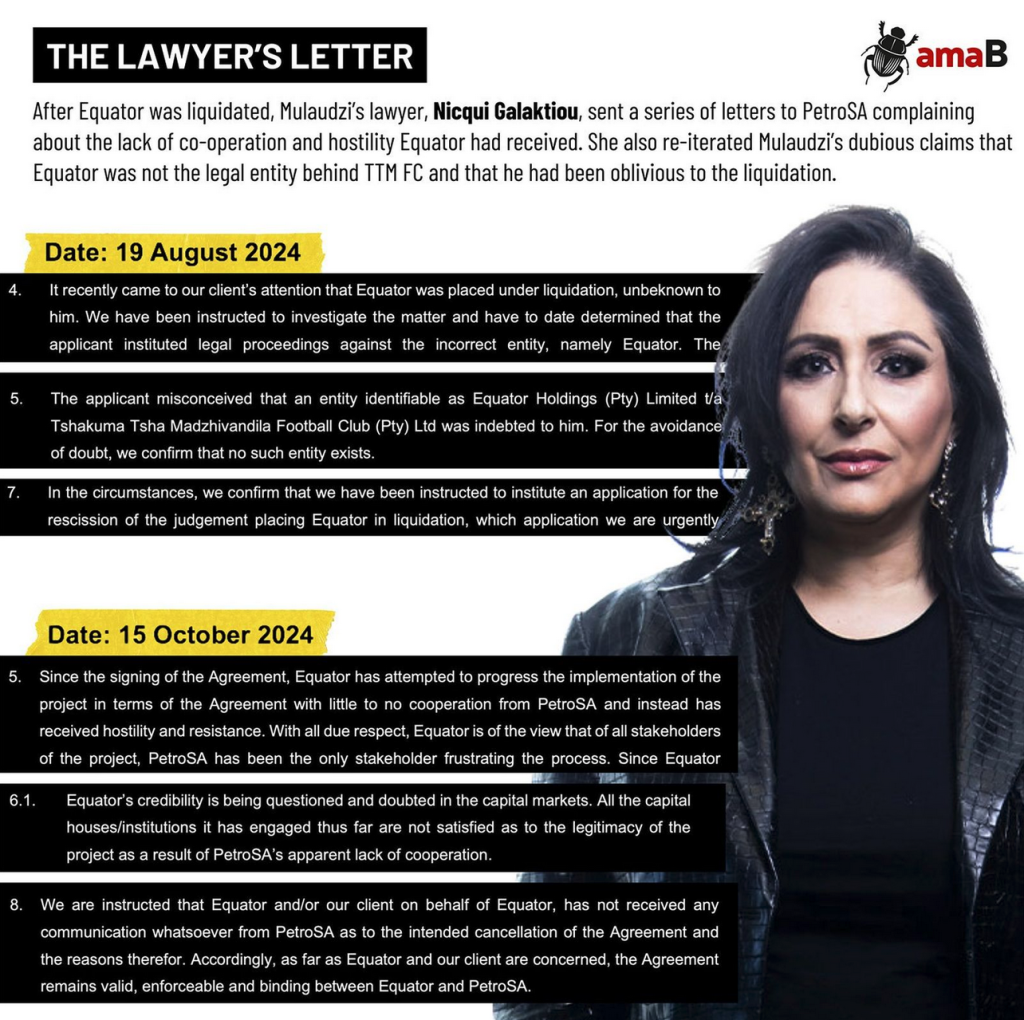
Equator, she added, “has not received any communication whatsoever from PetroSA as to the intended cancellation of the Agreement … as far as Equator and our client are concerned, the Agreement remains valid, enforceable and binding between Equator and PetroSA”.
The application to overturn the liquidation order — which had been granted seven months earlier — was “imminent”, she assured the PetroSA board.
In March 2025, the door opened even wider: Sesakho Magadla, the PetroSA official who had championed Equator’s cause and signed its contract, was brought back as interim CEO.
Getting Equator out of liquidation now became urgent.
Endless promises
When Mulaudzi approached the court in November 2024 to have Equator taken out of liquidation, he promised that all the creditors would be paid.
“I shall personally ensure that [Jampies] will be paid all the monies due to him,” he told the court, adding that this would extend to anyone else Equator owed money to: “I shall ensure that whatever claims these creditors entertain against [Equator] are paid promptly as and when they fall due once the liquidation is set aside.”
Mulaudzi has a history of leaving creditors unpaid, and one of them, Karen Fernandes, had heard these promises before. For years, she had been trying to get Mulaudzi to pay more than R500,000 that he owed to her company, Sure Gullivers Travel.
“I haven’t received any money at all, despite a lot of promises by Mr Mulaudzi — he says he’ll pay when he has the money,” she told amaBhungane when we contacted her recently.
She added: “He’s as smooth and slippery as they come. It’s inhumane — you can’t live a lifestyle like that [when you owe people money]”.
Fernandes was one of three creditors cited in the liquidation rescission case. The second creditor, Value Chain Construct, had done consulting work for Equator on a proposed gas plant. “We went the full course and settled with them through the courts,” director Jaco Human told us, adding: “We’re not owed any more. And most importantly, we’ve disassociated with them completely.”
The third creditor, Wood PLC, an international engineering consulting firm, confirmed that it also remained unpaid. “When Equator entered liquidation proceedings, an amount remained unpaid. Wood assessed the circumstances and decided not to pursue,” senior legal counsel Stefan van der Walt confirmed.
When Jampies filed his answering affidavit in January 2025, he begged the court not to believe Mulaudzi’s assurances that everyone would be paid.
“I have set out my past experience with Mulaudzi and, in particular, the empty promises he has made relating to payment to me in the past. I submit that this tender is nothing more than another one of his empty promises,” Jampies told the court.
In terms of court rules, Mulaudzi had 10 days to file a reply. Instead, eight months later, he presented the court with a settlement.
The cash settlement
In any liquidation, there is a strict hierarchy of who benefits from the assets. First in line are secured creditors, such as a bank that has issued a loan. Next are preferred creditors, such as SARS. And last are unsecured creditors, like Jampies.
With one caveat: before any creditors are paid, the liquidator must receive his or her fees. And because of the obvious potential that liquidators could overcharge, the Master of the High Court normally approves the liquidators’ fees.
By August 2025, Equator’s liquidators, Keevy and Barnard, had racked up fees of R350,000. So, when Mulaudzi approached the liquidators about a settlement, they were first in line.
The six-page settlement, filed in court a month later, was a climbdown: “Equator Holdings (PTY) Ltd T/A Tshakuma Tsha Madzivhandila Football Club acknowledges that it is truly and lawfully indebted to Cheslyn Chase Jampies in the amount of R725,000, together with interest,” it read, ignoring Mulaudzi’s earlier claim under oath that Equator was definitely not the legal entity behind TTM.
To settle with both the liquidators and Jampies, Mulaudzi agreed to “make payment to Cheslyn Chase Jampies and the Liquidators in the sum of R750,000 as a full and final settlement of the principal debt … together with the legal costs and administrative costs incurred by the liquidator”.
In other words, the R750,000 settlement would have to be split between Jampies and the liquidators.
Jampies did not want to speak about the case, but Keevy, the liquidator, confirmed that their fees were paid: “[I]t was agreed between Mr Mulaudzi and Mr Jampies that Mr Jampies would pay the liquidators’ costs and disbursements. Mr Jampies (via his attorney) was provided with a breakdown of how the fees and disbursements were made up and calculated … and at the request of Mr Jampies, a reduced settlement figure was provided to him, negotiated and agreed upon,” he told us via email.
This would not be overseen by the Master of the High Court, but instead would be a private deal signed by the liquidators, Jampies, Mulaudzi and seven witnesses.
“[T]he Master’s Office has no involvement in any alleged settlement agreements,” a spokesperson for the Department of Justice confirmed. “The Master’s Office does not participate in, negotiate, or facilitate settlement agreements between private parties in matters of this nature.”
In exchange, Mulaudzi would get exactly what he wanted: “Jampies and the Liquidators, to the extent permissible, shall not oppose the application to rescind the … court order” that had placed Equator into liquidation.
We asked Keevy and Barnard why none of Equator’s other creditors was included in the settlement. Keevy told us that none of the other creditors had come forward to prove their claim: “[A] liquidator can only have regard to proven creditors. Any other party who is not a proven creditor is simply a member of the public,” he said.
Fernandes, the travel agent, told us that Mulaudzi had persuaded her not to institute a claim. “He was saying I shouldn’t contact my lawyers because it’ll compromise the process. He refused to sign an [acknowledgement] of debt — he says he can’t make promises to me,” she said.
The resurrection of Equator Holdings
Even with the settlement signed and paid, there was no guarantee that Equator would be resurrected.
“[S]etting aside a winding up order is akin to raising the dead,” Werksmans attorney Jennifer Smit wrote in a 2023 article memorably titled “When a séance to raise the dead is permissible”, adding: “It is not a matter of simply coming to court to say that the creditors can now all be paid and that business is solvent.”
As Smit went on to explain, a liquidation order could only be set aside in “exceptional circumstances” and only when the directors have a “satisfactory explanation” for why they didn’t oppose the liquidation in the first place and file an appeal.
In Mulaudzi’s case, he had told the court under oath that he didn’t know about the March 2024 liquidation order until we published our article in July. But that claim was undermined by the WhatsApp and email trail showing that his own lawyer reached out about a settlement within days of the judgment being handed down.
All of this should have been weighed by the judge who presided over the rescission application in October 2025. But by this point, Jampies had withdrawn from the case — part of the deal in the settlement — and since the Master did not object, the judge granted Mulaudzi’s wish: Equator Holdings was back in business.
But when the newly resurrected Equator came knocking again, in November 2025, PetroSA should have shown it the door. Not just because of the liquidation, or Equator’s failure to find a funder, or even Mulaudzi’s apparent perjury, but because of a damning review by PetroSA’s own internal audit team.
The consortium
When PetroSA appointed Equator to act as its funder and infrastructure developer in May 2023, it thought that Equator had been selected through a fair tender process.
But in August 2024, PetroSA’s internal audit team had delivered a draft report to senior executives laying bare how flawed the original tender had been.
The non-negotiable was that bidders “must be an established player, or credible financial institution”. Equator may have been trading as a First Division soccer team, but it was not a credible financial institution.
So how, we wondered in our January 2024 investigation, had Equator been selected?
“Management comments”, included the draft audit report, show that Equator had listed several “project partners” in their bid, including Wood PLC, the engineering company that was now owed money, and TotalEnergies, the French oil major: “The evaluation was based on Equator and their Project Partners as a collective,” said the management team.
“It is common for such a complex project to have [a] consortium submission,” Sesakho Magadla, PetroSA’s then acting COO, told the internal audit team. “The evaluation team evaluated the bid holistically rather than just looking at Equator Holdings. The partners listed in this paragraph are well-known investment players in the industry. One can look at local and international major projects in oil and gas. They are generally done by [a] consortium, which can nominate a leader.”
In other words, it didn’t matter that Equator wasn’t a major player because TotalEnergies and Wood were on board. Right?
We contacted TotalEnergies to ask if it had been part of a consortium bidding for the PetroSA tender — it ignored our emails.
Mulaudzi and TotalEnergies are partners indirectly: in 2014, the Public Investment Corporation (PIC) agreed to fund a R1.8-billion buyout of TotalEnergies’ BEE partner, Tosaco. Mulaudzi’s Black Gold Investments owned 10% of the new BEE consortium.
But this in no way meant that the French oil giant was on board for a R20.3-billion deal with a state-owned entity that was teetering on the edge of its own liquidation.
Wood PLC, however, was unequivocal: “Wood was not involved in Equator’s bid for RFP0004/2023 and was not a project partner,” senior legal counsel Stefan van der Walt told us. “The company had no visibility of, or participation in Equator’s submission and any reference to Wood in Equator’s materials was made without our knowledge or approval.”
Scope creep
Another issue red-flagged by the internal audit team was that Equator had bid only for a contract to provide funding to PetroSA’s infrastructure expansion, yet the contract signed in December 2023 appointed Equator to both bankroll and execute the R20.3-billion project.
These were very different offers: no one wanted to fund PetroSA, which is why the tender had attracted just five bids. But now, Equator would be in charge of executing a massive infrastructure project.
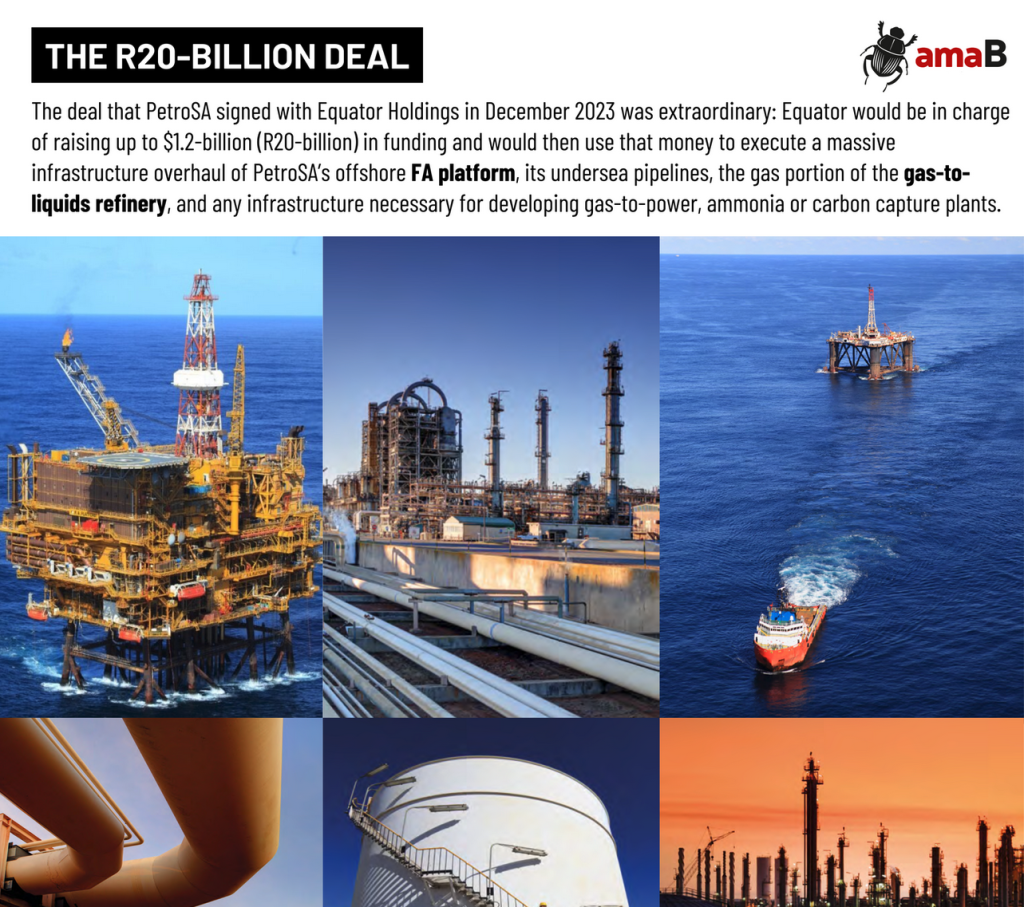
Equator was not an engineering company, so PetroSA agreed to give Equator six months to provide “evidence that it possesses the necessary technical capability” to handle the contract it had already been awarded.
This, the internal audit team concluded, was not only a breach of the Public Finance Management Act, but PetroSA could face lawsuits from other bidders who weren’t given the opportunity to bid on the same terms.
Magadla, who had been the acting COO and project sponsor, told the internal audit team: “During the negotiations, one of the major challenges to overcome was the fact that the asset was to remain the asset of the state and was not to [be] encumbered in any way. The funders needed assurance on how they would recover their investment.”
The only way to give that assurance was to sweeten the deal: “The only thing that was at PetroSA’s disposal is participation in the full project lifecycles,” she said.
PetroSA was so broke that its putting up funds itself was out of the question, she added. “It was even battling to cut grass on the basis of financial strain.”
The penniless partner
When the internal audit team delivered its draft report in August 2024, the management team had assured the auditors that they were in the process of cancelling Equator’s contract.
Technically, the contract had lapsed when Equator failed to deliver a funder by PetroSA’s June 2024 deadline. But even after Equator was placed in liquidation and control of the company was handed over to the liquidators, Mulaudzi had kept fighting to keep the deal alive.
Over the next year, Mulaudzi negotiated, paid and signed the settlement with Jampies and the liquidators that would bring Equator back to life.
On 1 December 2025, a small article appeared in Africa Intelligence, a niche website that often has the inside scoop on PetroSA: “Against all expectations, this month PetroSA asked its internal governance committee to go back on the termination of the gas contract with Equator Holdings … the public company sought the committee’s approval to restart discussions with Equator,” the article said, citing a confidential memo.
With a touch of salt, the article added: “The state firm has … reconfirmed its trust in this penniless partner.”
We tried to verify this with PetroSA, but the notoriously secretive state-owned entity would not budge. “PetroSA reserves its comment on RFP0004/2023 as the matter is currently sub judice,” it told us, adding that it was concerned about speaking publicly about matters that are before court.
(Public figures love to shout “sub judice” when confronted with tough questions. AmaBhungane’s advocacy co-ordinator Caroline James explains here why they’re deliberately misinterpreting the law.)
There are no court challenges to the Equator tender (RFP0004/2023), but as PetroSA explained, there is a case against a related tender, RFP0001/2023, which was awarded to the sanctioned Russian bank Gazprombank.
Ironically, the scope creep that the internal audit team had red-flagged in its report meant that Equator’s R20.3-billion contract had trespassed into Gazprombank’s scope of work. So for the foreseeable future, PetroSA would be staying silent. DM