By Farai Shawn Matiashe | 4 September 2025
Zimbabwe has stringent anti-pollution laws to prevent illegal gold mining, yet on the banks of one river in eastern Zimbabwe, miners, and police, are present. Correspondent Farai Shawn Matiashe investigates how police are in cahoots with the illegal miners.
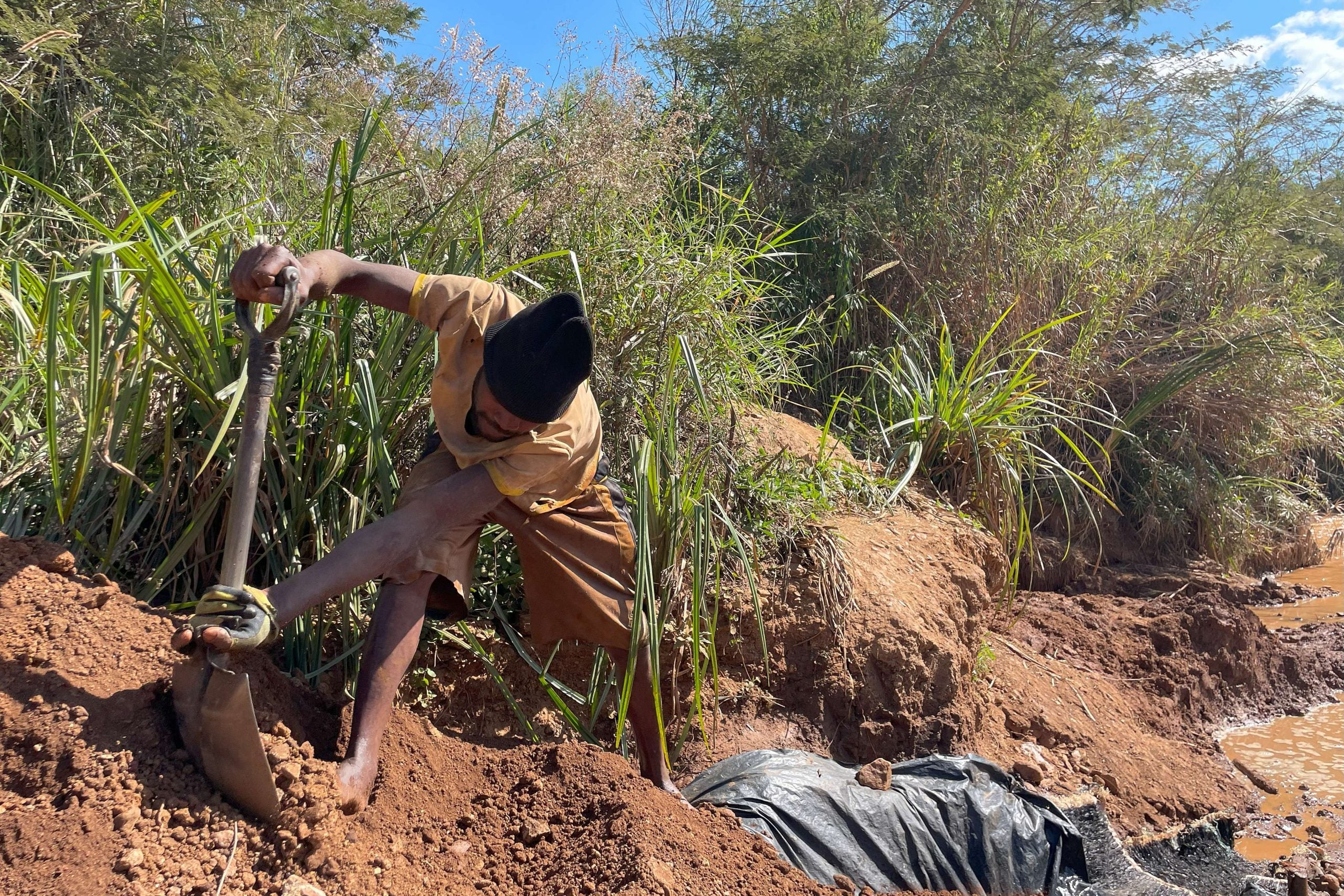
On a chilly Tuesday morning in June 2025, in an area called Magetsi on the banks of the Mutare River in eastern Zimbabwe, a crew of 10 men in dirty overalls and worn-out trousers wade into the shallows from the muddy banks. It is the start of a long shift.
They carry shovels, picks and plastic basins – crude tools with which they work slowly to separate gold dust from the river’s mud.
Untold ecological damage
They are young, strong, unemployed and desperate. These men – and hundreds of others working at such sites along this same stretch of river – see this as their only way out of poverty.
Against a backdrop of chronic unemployment, one gram of gold fetches $70 on the black market.
On a good day, some miners interviewed for this story said, one miner can retrieve up to half a gram of gold.
But these are not just miners; they are also criminals. As of December 2024, alluvial mining has been outlawed in Zimbabwe in the government’s bid to protect Mutare and other river ecosystems from erosion and pollution, which has caused untold ecological damage in recent years.
These men carry with them vials of mercury, which they mix into their basins to trap the gold.
When this mercury is burned off, leaving the gold behind, it seeps into the ground or is washed back into the river. At some sites, cyanide is also used in the process.
After years of unchecked alluvial mining, the waters of the Mutare River downstream from the miners have become toxic, harming the communities that once relied on them for irrigation, livestock and drinking.
Miners ‘register’ with corrupt police for protection
Despite the damage they cause and the laws they break, these men do not fear arrest or imprisonment. An arrangement has been worked out.
They are “registered”, they say, with the police officers tasked with patrolling this stretch of river.

By around 11am at the Magetsi site, the chorus of voices, water pumps and pickaxe blows is in full swing.
Then four men – plainclothes police officers – appear on foot. The miners fall silent.
The crew’s leader, known as Tee, walks over, speaks to them briefly and slips a folded $5 note into one officer’s hand. The man tucks it into his back pocket and leaves with his companions. The tension eases, and the chatter soon resumes.
“They only take cash, so it cannot be traced,” Tee says.
This is neither a furtive moment nor an isolated one. Over three separate days between June and July, this reporter visited half a dozen alluvial mining sites along a 10km stretch of the Mutare River – from Penhalonga, past Africa University and Premier Estate, down to the Odzi River – and either witnessed or repeatedly heard accounts of such bribes changing hands.
Once you speak to them nicely, you should know the language here
Despite a government ban and subsequent legal changes, enforcement is failing.
According to more than 20 miners and locals interviewed, the reason is simple: police officers are extorting protection money instead of arresting or deterring illegal miners.
A law with no teeth
Zimbabwe’s Environmental Management Act, amended in December 2024, now carries stiff penalties for offenders of the alluvial mining ban – fines of at least $5,000 or up to 12 months in prison.
With the criminalisation of the practice, responsibility has also fallen onto the police in Zimbabwe to work with the country’s Environmental Management Agency (EMA) to enforce the ban.
Near Penhalonga, 17km from the city of Mutare, alluvial mining is rampant. Crackdowns by police and EMA officials occasionally scatter the miners, and some are arrested and languish in jail until their colleagues raise bail.
But the crews who have police officers on their payrolls are long absent from their stations when the government’s raiding party arrives.
They only take cash, so it cannot be traced
They are tipped off, they say. That information is one of the most important services they buy with hefty bribes.
“Once you speak to them nicely, you should know the language here,” explained a miner called Fatso, interviewed where he worked with a crew of 12 men near Africa University Road. The “language” he refers to is a bribe – money talks.

His crew of 12 men pays about $20 whenever police officers – sometimes dressed in uniforms, often in civilian clothes – arrive for their twice-weekly patrols. In some places, other miners told us, it’s three times a week, and the amounts may be even higher.
Gaining access to people like Fatso, his colleagues, and the sites they mine is not easy for an outsider. The miners have a reputation for quickly resorting to violence when rivals or intruders encroach on their turf.
This reporter’s access was made possible by one miner who agreed to take time off work to act as a guide and intermediary across the mine dumps and wastelands that line this stretch of the Mutare River.
Between June and July, we spent three days together in the field.
Day one: Mistaken identity
On the first day, we walked 5km along the river, downstream from the point where the Nyanga-Mutare road crosses the Mutare River.
Here, the Mutare was choked with sand heaps and diversion channels cut by miners and then abandoned. The water ran a dirty brown and carried the smell of chemicals.
Near Africa University, we met a miner named Chirombo, originally from Wengezi. At first, he mistook this reporter for a police officer.
Placing his palm on his chest, he asked in a low, submissive voice: “We were with you yesterday, and today you are here again. Is this what we agreed?”
He was reassured to learn that we were there only to observe and ask a few questions.
Our group is charged $20. Sometimes they come on weekends too. If you want to work peacefully, you must first ‘register’ with them
For Chirombo and his group of seven, every Tuesday, Thursday and occasional weekends bring the same ritual: pay the $5 demanded or risk arrest, confiscation of tools or detention until colleagues raise bail money.
Day two: In plain sight
On our second day in the field, deeper into Mutasa district, we met Fatso, a miner from Honde Valley to the north.
His crew was panning for gold barely 300 metres from a police outpost manned by the elite Support Unit of the Zimbabwe Republic Police.

Fatso named one officer, known by the nickname Medic, who patrols twice a week to collect dues.
“Our group is charged $20. Sometimes they come on weekends too. If you want to work peacefully, you must first ‘register’ with them,” he said.
The work these men do is both primitive and toxic. Pumps draw water from the river to wash the shovelled gravel, which is piled high before being sifted. Mats trap flecks of gold, and mercury is mixed by hand to bind the particles. The process produces a toxic silver bead that is burned in an open fire to release the gold.
There are no gloves, no masks, no toilets. We walked past human excrement in the sand. Frogs, fish, and other forms of life seemed to have vanished from the river.
Day three: A bribe changes hands
Magetsi – a rough patch reached by a bumpy dirt road from Premier Estate – was where we saw the bribe change hands.
Wearing old work trousers, we mingled with Tee’s group of 10 miners. The moment Tee slipped a $5 note to a police officer was casual, almost routine.
Tee explained later that the police never give names or show IDs. They use nicknames, arrive in groups of four or five, and prefer plain clothes. Those who pay are warned of raids; those who don’t, Tee said, are arrested without mercy.
Among the miners we spoke to was Tinashe, barely 20, his clothes filthy and his face tired. He works near Africa University and makes about $30 on a good day.
“I have never been arrested. But I know some who were, and were released only after paying a fine,” he said.
“We pay them $5, otherwise, they take your tools.”
Further downstream, Tamuka, another miner, explained that his 10-man crew operates under ‘sponsors’ who supply pumps, picks, shovels and food.
After selling their gold – often to buyers disguised as beer vendors – they repay the investment.
Some of the gold, he said, is smuggled across the border into Mozambique. Other portions are sold to licensed dealers from Harare, from where it likely makes its way to the Fidelity Gold Refinery, controlled by the Reserve Bank of Zimbabwe.
Environmental activists agree; government deflects
Civil society organisations corroborated the miners’ accounts. But when questioned, officials downplayed allegations that police corruption underwrites illegal alluvial mining along the Mutare River.
“They work together with the police,” said Farai Maguwu, director of the Centre for Natural Resource Governance.
“If an operation is ordered from above, the police warn artisanal miners to disperse and return later.”
He described miners digging in the river’s midstream, altering its flow, and dumping mercury – “a deadly chemical” – into the water.

When queried, police spokesperson Paul Nyathi insisted that Commissioner General Stephen Mutamba has “zero tolerance” for corruption and urged people to report it. But he added: “Issues of mining are not handled by police alone. If there are any issues, the police will react.”
EMA spokesperson Amkela Sidange described enforcement as a “group responsibility”, requiring coordination between agencies.
I have never been arrested. But I know some who were, and were released only after paying a fine. We pay them $5, otherwise, they take your tools
Neither addressed the widespread allegations of bribery.
Mines minister Winston Chitando did not respond to requests for comment.
A river in peril
The Mutare River winds from Penhalonga through forests and farmland before feeding into the Odzi and Save Rivers, which eventually drain into the Indian Ocean.
Once a source of water and life, it is now a corridor of silt, toxic sludge and mining waste.
Across the country, more than 1,500 km of river ecosystems have been degraded by alluvial mining, according to EMA. Along the Mutare, the damage is plain to see: collapsing banks and poisoned water.
If an operation is ordered from above, the police warn artisanal miners to disperse and return later
For the miners we met – Chirombo, Fatso, Tinashe, Tamuka, Tee – illegal gold mining is a choice born of survival in a collapsed economy. It outweighs any concern for the environment or the law. The same is true for the police officers who prey on them and their crews.
- This report has been produced by the Southern Africa Accountability Journalism Project (SA | AJP), an initiative of the Henry Nxumalo Foundation with the financial assistance of the European Union. It can under no circumstances be regarded as reflecting the position of the European Union.