By Vicky Abraham| 7 April 2026
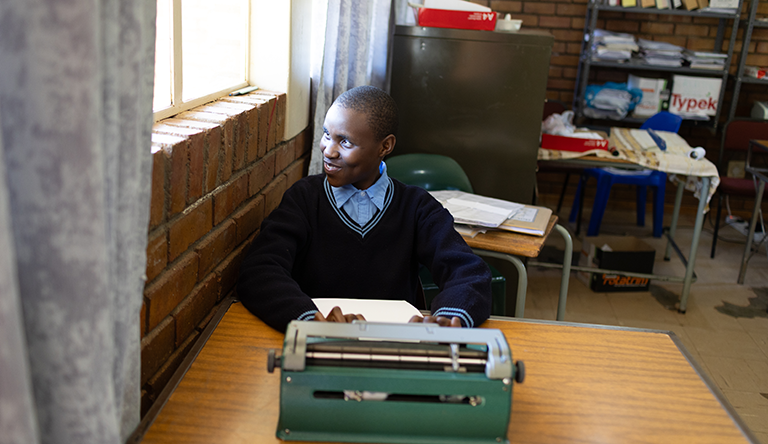
For many disabled children in South Africa, access to education comes at a price their able-bodied peers do not have to pay.
Public schooling is meant to be free for children in poor communities. Yet the families of children who are blind, deaf or with different disabilities are often forced to spend money on transport, boarding and sometimes school fees to secure a place in a special-needs school.
Because these schools are scarce, many children have ato travel long distances or live in hostels far from home.
Basic education spokesperson Lukhanyo Vanqa said quintile-based funding, which designates certain schools as “no-fee” schools, did not include special- needs schools because their funding depended on the nature of disabilities rather than catchment-area poverty.
But Vanqa said the department acknowledged that these schools had “systemic” issues — which he did not identify — that the directorate of inclusive education was addressing.
Sarah Masuku, from Ekukhanyeni (Kwaggafontein), Mpumalanga, pays for her two blind children’s schooling with their grant money, meaning there is less income available for the household.
“My husband and I are unemployed,” she said. “We have nine children, and the two youngest are blind. Only one of my children does piece jobs as a domestic worker, and she can only buy us sugar or mealie meal. The rest are unemployed. So, we all depend on the two disability grants.”
Masuku says covering school costs for her children has been a burden.
“With the one who just completed matric, we were paying R4,000 per year, or R1,000 per term. The one at Silindokuhle [a special school in eMangweni, Mpumalanga] costs R2,800 per year, and we have to buy 30 rolls of toilet paper, 10 tubes of toothpaste, snacks, 3kg washing powder and provisions. I struggled to pay the R2,800.”
For families living on disability grants, even small fees can become unaffordable. A disability grant was R2,315 a month until this week, when it rose to R2,400. It is intended to help families meet the additional costs of caring for these children — not to pay for access to schooling.
Yet in many cases the grant becomes the only way families can cover the costs of boarding, transport or school fees.
Data collected from special schools showed boarding fees range from about R2,500 to as much as R38,000 a year, depending on the province. Day schooling is sometimes free, but at least one special school surveyed charged day-school fees of up to R17,000 annually.
In some cases, children travel more than 400km to access a suitable school. Even within provinces, journeys can exceed 100km, making daily commuting impossible.
Sometimes, pupils with disabilities have to relocate to neighbouring provinces. This places additional financial pressure on families.
Angel Mashego, 16, and her sister, Princess, 15, attend Bosele School for the Blind and Deaf in Monsterlus, Limpopo, due to a shortage of special schools in Belkop, Mpumalanga, where they live. They travel two hours every term to the school, which charges R2,500 a year.

During holidays at home, the sisters live in a mud house with their mother Florence Mdluli, who is partially blind, and their grandmother Martha Mvuleni, who is totally blind.
“We sleep on the floor. When it rains, it comes inside. Our house is falling apart. We eat in the morning and at night only. During the day there is no food. We want a decent home, food, and clothes,” said Angel.
“We wear old clothes given by our aunt. Our uniform is not in good condition.
Our grandmother and mother are not working. If there are no leftovers, we will not eat in the morning. Recently, a wall nearly fell on my mother at midnight, but we managed to save her.”
For many families, the cost of education competes directly with basic survival.

The Social Assistance Act says children receiving care dependency grants should not be cared for on a 24-hour basis in state-funded institutions for periods exceeding six months. Yet many pupils with disabilities remain in boarding facilities for extended periods because there are no schools closer to their homes.
The UN Committee on Economic, Social & Cultural Rights states that education should be physically accessible at a reasonably convenient location, such as a neighbourhood school — a standard that is often not met for children with disabilities in South Africa.
Civil society organisations that advocate for the right of poor children to free, quality education are concerned.
“We are worried that children with disabilities have to live in school hostels, away from their families and communities,” said Anjuli Maistry of the Equal Education Law Centre.
“All children, regardless of ability, should be able to access education close to home, and in many cases being unable to do so amounts to differential treatment that could be discriminatory. Compounding this differential treatment is the fact that the parents are forced to pay fees and hostel fees, regardless of their socioeconomic background.”
Jabulane Blose, the CEO of the South African National Deaf Association, said charging children with disabilities puts them at a “structural disadvantage from the outset” and “entrenches inequality in access to basic education”.
“Many families of children with disabilities already face significantly higher costs related to disability-specific needs, including transport, assistive technologies, therapy, and communication support,” he said.
Nomahlubi Khwinana, commissioner for the South African Human Rights Commission, said the necessity for families to use disability grants to pay for basic education “may raise important constitutional concerns”.
“Should a formal complaint or further information be submitted, the commission would be in a better position to assess whether the practice has the effect of unfairly burdening learners with disabilities and their families.”
Fannie Mashapu, president of the South African National Association for Special Education, said parents of children with disabilities do not send their children to boarding schools by choice.
“We therefore believe the hostel costs must be borne by government,” he said.
Vanqa agreed that it was not appropriate for children to stay in boarding schools for months. “The declaration of special schools depends heavily on a funding policy that will apply uniformly. If a school is provided with all the
resources in the policy, such a school can then be declared as no-fee. The system does not have a funding policy for special schools,” he said.
Vanqa said “parents have the right to decide if the school can charge fees” but did not clarify how these decisions were made in practice.
“In some provinces, the government does cover or subsidise transport or boarding costs for learners, particularly those who live far from schools or face financial challenges. However, this support is not consistent across all provinces. In other areas, it may be limited or not available at all due to differences in funding, policies, and implementation. As a result, while such assistance does exist, it is not universally provided and can be relatively rare in certain regions.”
- Vicky Abraham is an investigative journalist for Diary Series of Deaf People (www.thedeafdiary.com). This story first appeared in Sunday Times.